Strategy Automation
Your Strategy, Running Without You Watching
The Sterling Partners automation engine turns your entry and exit rules into a deployed, monitored, and auditable live strategy — without requiring a quant team to maintain it.
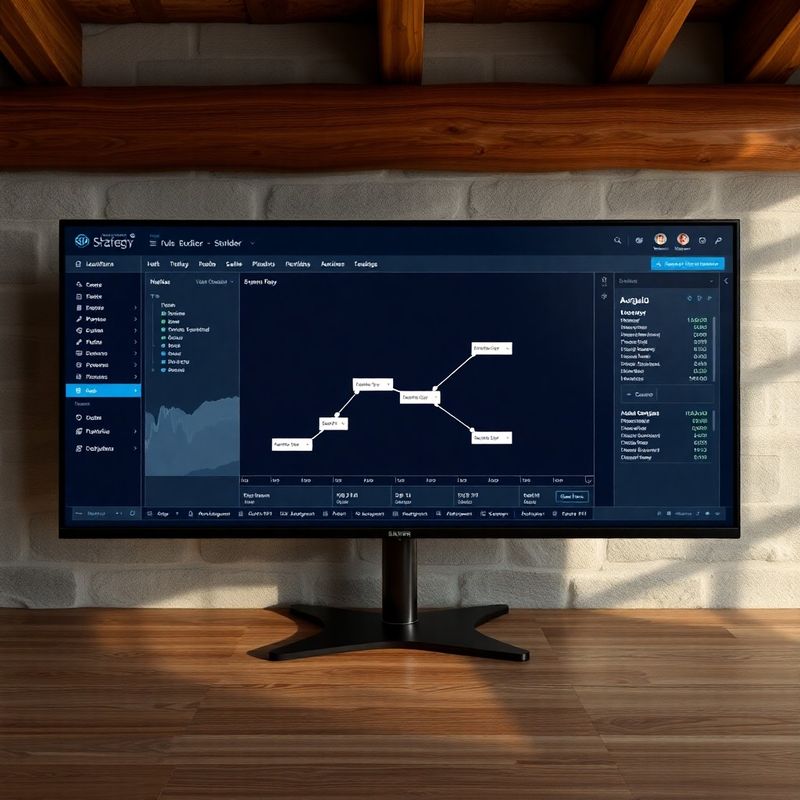

Strategy Automation
The Sterling Partners automation engine turns your entry and exit rules into a deployed, monitored, and auditable live strategy — without requiring a quant team to maintain it.
You define your strategy logic using the visual rule builder — drag-and-drop conditions, indicators, and time filters — or write it directly in Python using our open SDK. Once validated against historical data in the backtesting module, you promote the strategy to paper trading for live-feed simulation, then to live execution with a single confirmation. The engine handles FIX order routing to your connected broker, position sizing based on your account equity, and real-time P&L attribution so you always know which rule generated which return.
Whether you code or prefer a visual interface, the automation engine meets you where you are.
Configure multi-leg conditions using over 80 built-in indicators and order types. No code required. Rules are stored as version-controlled JSON so you can diff changes, roll back to a prior version, or share configurations with your team.
Full programmatic access to the order router, position manager, and event bus via our open-source Python SDK. Bring your own NumPy-based signal logic and let the platform handle execution infrastructure — authentication, retry logic, and rate limiting included.
Every running strategy has its own tab: fill latency, slippage vs. theoretical, drawdown vs. target, and a chronological event log of every signal fired. If something behaves unexpectedly, you see it within seconds, not at end-of-day reconciliation.
“We moved our mean-reversion equity strategy from a spreadsheet-triggered script to the Sterling Partners Python SDK in about three days. Slippage dropped noticeably and we stopped babysitting the terminal every morning — the monitoring tab flags anything unusual before we even open our laptops.”
Tomaž Bergant, quant analyst, Celje
The platform executes the strategy you define — it does not design strategies on your behalf, and it does not guarantee that any automated strategy will be profitable. Market conditions change; a strategy with a strong backtest can still underperform live due to regime shifts, structural market changes, or edge cases not present in historical data. The automation engine is a precision execution tool: the quality of the output depends entirely on the quality of the logic you supply.
Our onboarding team will walk you through SDK setup and your first paper-trading session — usually completed in under two hours.
Contact us